How to Build a Repeatable Product Test Checklist for Arc Lighters
Learn how to build a rigorous, repeatable testing checklist for arc lighters, covering IP56 waterproofing, battery degradation, and critical safety standards.
Executive Summary
To construct a repeatable arc lighter test checklist, evaluators must rigorously measure three core pillars: electronic safety mechanisms, environmental resilience (IP ratings), and long-term battery health. Effective testing protocols require verifying a 7-10 second automatic shut-off cycle, validating IP56 moisture protection for survival-grade models, and confirming consistent maintenance of a 5mm arc gap. Because a standard 1-2 hour charge yields between 60 and 300 ignitions depending on the model, standardized baseline testing is critical for addressing primary user pain points like battery degradation and restricted ignition zones.
Failure Mode Analysis: Why Testing Matters
Understanding where arc lighters fail in the field dictates what must be tested in the lab. Battery degradation accounts for nearly half of all device failures, underscoring the need for rigorous charge-cycle testing.
Market Baselines for Testing Protocols
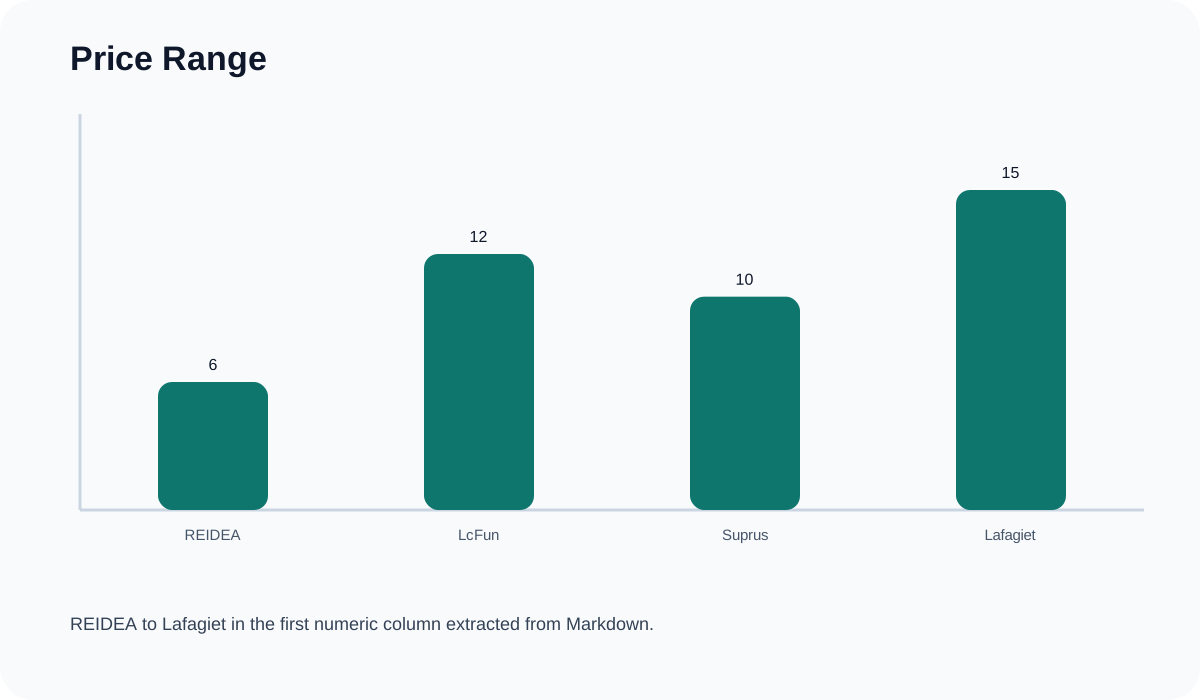
Before finalizing a checklist, it is necessary to establish the standard performance benchmarks across leading market entities, including REIDEA, LcFun, Suprus and Lafagiet.
| Brand | Model | Price Range | Waterproof Claim | Battery Life (Per Charge) | Charging Method |
|---|---|---|---|---|---|
| REIDEA | R1 Pro Candle Lighter | 25 | Splashproof | 200+ Ignitions | USB-C |
| LcFun | Outdoor Dual Arc | 18 | IP56 Rated | 300 Ignitions | USB-C |
| Suprus | Classic Arc | 15 | None | 100+ Ignitions | USB-C |
| Lafagiet | Survival Torch | 20 | IP56 Rated | 250 Ignitions | USB-C |
Key Analysis Sections
1. Battery and Ignition Cycle Validation
Battery runtime is the primary source of user complaints. A repeatable test must evaluate the benchmark of a 1-2 hour full charge yielding between 60 and 300 ignitions. Testing should confirm that the battery can withstand up to 500 lifetime charge cycles without entering thermal runaway. Additionally, real-world utility is often bottlenecked by the standard 5mm arc gap, making tinder preparation a necessary variable in ignition performance testing.
2. Environmental Resilience and IP56 Certification
Waterproof claims vary significantly across manufacturers. For outdoor and survival models, a checklist must verify IP56 certification standards. This requires physical inspection and moisture testing of the O-ring seals and secure casing latches to ensure internal circuitry remains isolated from shorts caused by water ingress.
3. Electronic Safety and Thermal Management
Safety standard testing is non-negotiable. Evaluators must verify the presence and reliability of a 7-10 second automatic power-off switch, which prevents electrode overheating and mitigates the risk of lithium-ion thermal runaway. Testers must also account for ozone production and electrode heat management during continuous operation.
The Repeatable Product Test Checklist
Use this standardized checklist to evaluate any arc lighter reliably:
- Charge Validation: Verify the device reaches full battery capacity within the 1-2 hour estimated window.
- Cycle Testing: Execute continuous ignition cycles to confirm the device meets its stated per-charge lifespan (60 to 300 ignitions).
- Safety Shut-off: Activate the arc and time the automatic shut-off mechanism; it must disable power between 7 and 10 seconds.
- Arc Gap Measurement: Measure the node distance to ensure a standard 5mm arc gap is maintained.
- Seal Inspection: Inspect O-rings and physical latches on IP56 models for secure, uniform contact.
- Moisture Exposure: For IP56 rated models, subject the closed device to high-pressure water jets, followed by an immediate ignition test.
- Electrode Assessment: Check for rapid electrode corrosion or excessive buildup after 50 continuous test ignitions.
Final Verdict
Building a repeatable test checklist for arc lighters limits subjectivity and exposes the reality behind manufacturer claims. By adhering to strict parameters regarding 7-10 second auto-offs, 5mm gap ignition capabilities, and IP56 integrity checks, reviewers and buyers can accurately separate reliable survival tools from novelty gadgets.