Best Charging Gear for Hunters Running GPS and Arc Lighters
Discover the most reliable power banks for backcountry hunting. Compare rugged chargers, battery runtimes, and winter weather performance for GPS and arc lighters.
Executive Summary
For modern hunters navigating remote backcountry, reliable portable power is no longer optional. Maintaining charge for safety beacons, GPS mapping units, and electric arc lighters requires a dedicated power strategy. Based on field tests and industry data, the most effective charging gear relies on ruggedized, high-efficiency 10,000mAh lithium-ion power banks featuring IP67 or IP68 weatherproofing.
The Dark Energy Poseidon Pro currently stands as the industry standard for maximum durability (IP68), while the Nitecore NB10000 Gen 4 provides a highly competitive ultralight alternative (IPX7) for mobile hunters. When selecting a power ecosystem, hunters must account for “cold-soaking”—a phenomenon where lithium batteries lose up to 50% of their effective capacity if left in freezing packs overnight. Success in the field dictates pairing waterproof banks with braided cables and utilizing low-current charging modes specifically designed for arc lighters.
Power Demands in the Backcountry
Understanding your electrical draw is the first step to building a reliable backcountry kit. A standard 10,000mAh power bank can comfortably sustain a hunter’s essential electronics for a typical 3-to-5-day excursion.
Note: An arc lighter recharge typically yields between 45 to 300 ignitions per charge, making it a highly efficient survival tool despite acting as a potential single-point-of-failure without backup power.
Top Power Banks for Hunters
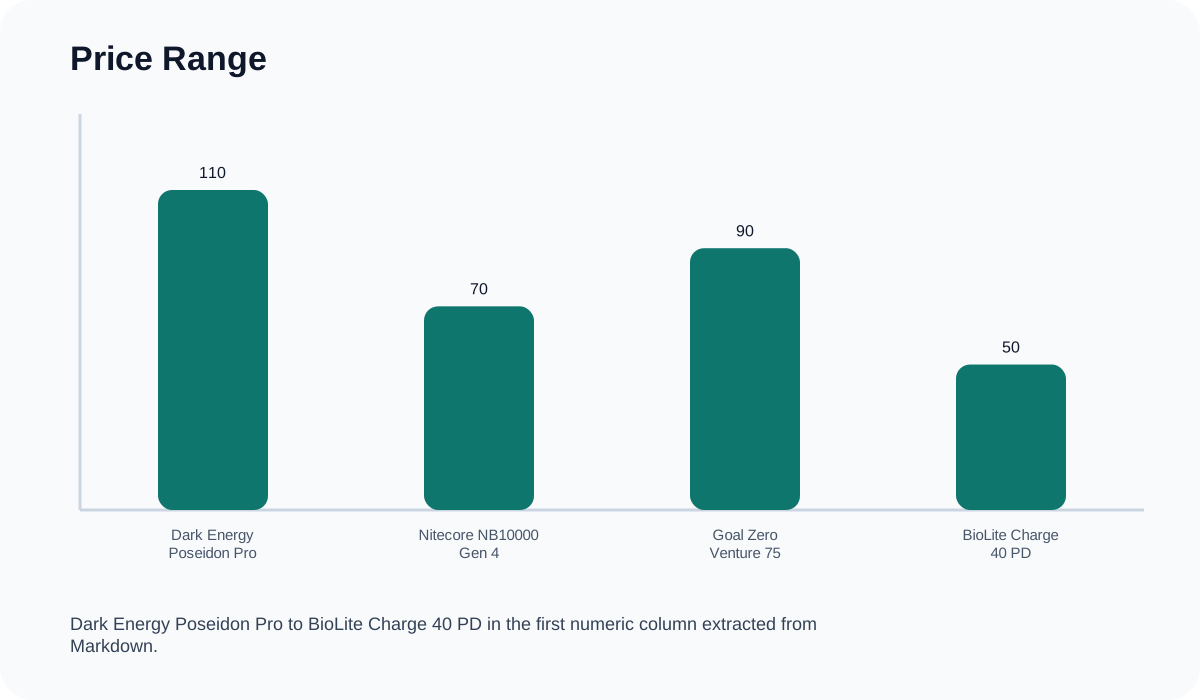
The shift toward USB-C Power Delivery (PD) has streamlined charging, but not all battery housings survive the rigors of hunting. Below is a comparison of the leading power sources for 2026.
| Product | Price Range | Capacity | Weight | IP Rating | Key Benefit |
|---|---|---|---|---|---|
| Dark Energy Poseidon Pro | 130 | 10,200 mAh | 9.6 oz | IP68 (Submersible) | Military-grade durability |
| Nitecore NB10000 Gen 4 | 85 | 10,000 mAh | 5.3 oz | IPX7 (Waterproof) | Ultralight carbon fiber build |
| Goal Zero Venture 75 | 110 | 19,200 mAh | 20.3 oz | IP67 (Dust/Waterproof) | High capacity for week-long hunts |
| BioLite Charge 40 PD | 65 | 10,000 mAh | 9.3 oz | No official IP (Rugged) | Stainless steel housing |
The Rugged Champion: Dark Energy Poseidon Pro
For hunters in extreme environments, the Poseidon Pro is the benchmark. With its IP68 rating, it survives full submersion and sub-zero temperatures far better than standard consumer-grade chargers. Its sealed ports are critical for preventing mud and field-dressing debris from causing short circuits.
The Ultralight Choice: Nitecore NB10000 Gen 4
Weighing an estimated 5.3 ounces, this carbon fiber unit solves a major pain point: weight fatigue. Its recent upgrade to an IPX7 rating makes it a viable competitor for backcountry elk hunters who count every ounce but still require waterproofing.
Solving Real-World Charging Pain Points
Testing reveals that technical failures in the field rarely stem from the power bank itself, but rather from environmental mismanagement and cabling.
- Cold-Soaking and Thermal Runaway: A lithium-ion battery left in an external pack overnight can lose up to 50% of its capacity to cold-soaking. Furthermore, attempting to charge a device when the battery is below 32°F risks thermal runaway. Solution: Keep power banks and GPS devices in an internal jacket pocket close to body heat before and during charging.
- Weight Distribution vs. Capacity: Carrying a massive 20,000mAh bank (like the 20.3 oz Goal Zero Venture 75) is often too heavy for mobile hunters. Solution: Packing two 10,000mAh units provides better redundancy and allows for balanced weight distribution.
- Cable Failures: Proprietary or low-quality cables become brittle and snap in cold weather. Solution: Hunters should upgrade to braided charging cables from reliable brands like Dark Energy or Anker.
- Solar Inefficiency on the Move: Attempting to charge a GPS or arc lighter directly from a solar panel while hiking results in erratic voltage due to moving shadows. Solution: Use panels (like the BigBlue 28W) solely at basecamp to charge an intermediary power bank, which safely regulates output to delicate devices.
Safety Best Practices for Arc Lighters
Arc lighters—like the Survival Frog Tesla Lighter—are excellent windproof fire starters, but their internal micro-batteries are highly sensitive.
- Voltage Regulation: Arc lighters are susceptible to over-voltage. Always utilize the original charging cable or pair the lighter with a high-quality USB-C PD bank equipped with a smart IC chip to prevent frying the internal board.
- Low-Current Modes: Arc lighters draw extremely low amperage during a charge. Many high-capacity banks will automatically shut off because they do not register the minimal draw. Premium banks feature dedicated “trickle charge” or “low-current” modes specifically required for these micro-devices.
Final Verdict
For stationary basecamps or extended week-long hunts, high-capacity models like the Goal Zero Venture 75 provide peace of mind. However, for mobile backcountry hunters carrying critical GPS tech (like the Garmin inReach Mini 2) and electric arc lighters, a dual-battery strategy is highly recommended. Pairing a Dark Energy Poseidon Pro for bulletproof reliability with a Nitecore NB10000 Gen 4 as an ultralight backup ensures redundant power, prevents single-point failures, and minimizes pack weight.
Backcountry Charging Checklist
- Pack at least one power bank with an IP67 or IP68 waterproof rating.
- Verify the power bank has a “low-current” or “trickle charge” mode for arc lighters.
- Include braided USB-C cables to prevent cold-weather snapping.
- Ensure rubber port covers are intact to block dust and moisture.
- Store power banks in internal layers to prevent cold-soaking capacity loss.
- (If using solar) Pack a dedicated intermediary bank to stabilize solar voltage.