Best Bug-Out Bag Electronics That Earn Their Weight
Discover the top survival electronics of 2026 based on weight-to-utility ratio. Compare power banks, SOS communicators, and emergency radios.
Executive Summary
In 2026, the gold standard for bug-out bag electronics centers on the “Weight-to-Utility Ratio.” Devices must offer multi-functional redundancy or critical life-saving capabilities to justify their pack weight. The trend has shifted toward ultralight carbon-fiber power banks and satellite-linked SOS communicators that provide up to 14 days of runtime, while traditional heavy hand-crank radios are being refined into compact hybrid units. Real-world performance data emphasizes that IPX7 waterproofing and USB-C standardization are now mandatory for survival-grade gear to ensure reliability in extreme conditions.
The 150g Rule and Efficiency Index
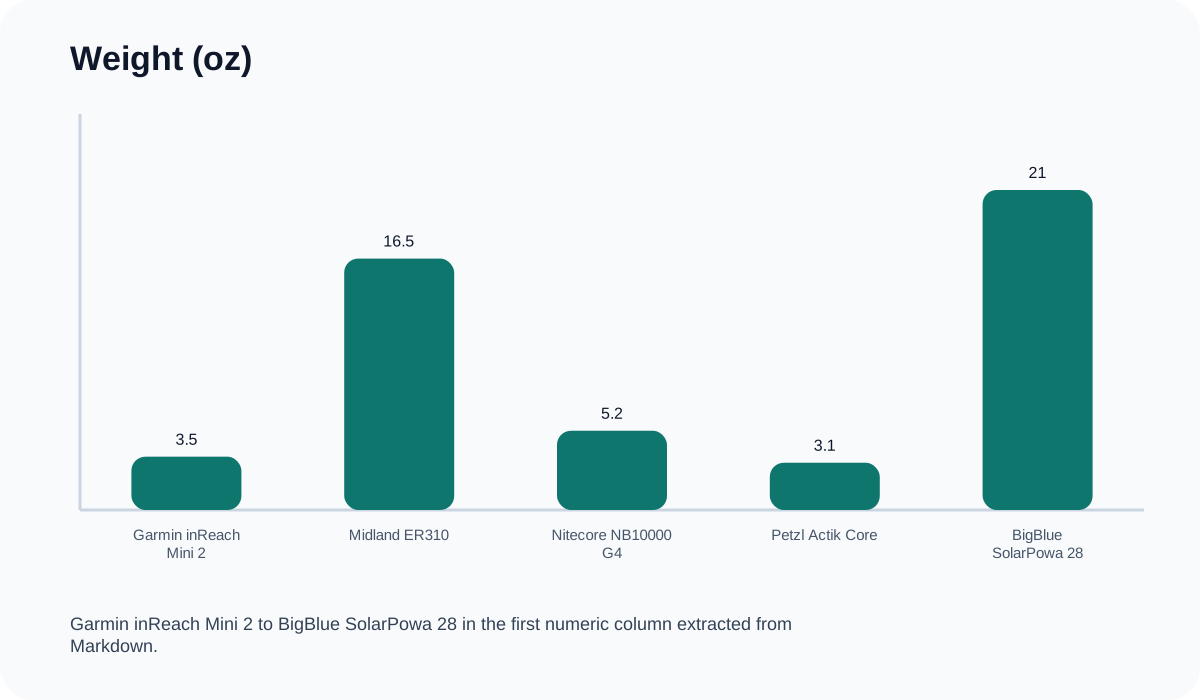
Survivalists now categorize gear by strict weight efficiency utilizing the “150g Rule.” If a device adds more than 150 grams (approximately 5.3 oz) without solving a verified problem—specifically signal, power, or light—it is considered dead weight.
Top Survival Electronics Comparison (2026)
| Product | Category | Weight (oz) | Price Range | Waterproof Rating | Primary Charging |
|---|---|---|---|---|---|
| Garmin inReach Mini 2 | Comm/GPS | 3.5 | 400 | IPX7 | USB-C |
| Midland ER310 | Radio/Light | 16.5 | 75 | Weather-Resistant | Hand-Crank/Solar |
| Nitecore NB10000 G4 | Power Bank | 5.2 | 90 | IPX5 | USB-C |
| Petzl Actik Core | Lighting | 3.1 | 85 | IPX4 | Hybrid (USB/AAA) |
| BigBlue SolarPowa 28 | Solar | 21.0 | 80 | IP67 | Solar |
Analysis of Leading Bug-Out Electronics
SOS as a Lifeline: Garmin inReach Mini 2
Satellite communicators have become essential for non-grid communication. The Garmin inReach Mini 2 dominates this category, weighing just 3.5 oz while providing up to 336 hours of tracking battery life. Users consistently prioritize its reliable physical interface over high-end touchscreen models, as capacitive screens become unresponsive when wet or when the user is wearing thick gloves.
Carbon Fiber Dominance: Nitecore NB10000 Gen 4
The Nitecore NB10000 Gen 4 is currently cited as the most efficient power source per gram on the market. It delivers 10,000mAh of power at merely 5.2 ounces. While it sets the standard for ultralight power, field data indicates it suffers from reduced efficiency in extreme cold, meaning users must insulate the unit during winter deployments.
Hybrid Charging Redundancy: Midland ER310
Leading emergency radios must justify their heavier footprint. The Midland ER310 earns its 16.5 oz weight by combining a flashlight, NOAA weather alerts, and a 2600mAh battery. Its critical advantage is redundant charging capabilities; it can be topped off via integrated solar, a mechanical hand-crank, or standard AA batteries.
Pain Points and Safety Considerations
While modern survival electronics are highly capable, real-world field tests highlight several physical and operational vulnerabilities:
- Parasitic Drain: Emergency radios left in bags for 6+ months often have dead batteries when needed. Regular maintenance and charging cycles are required.
- Subscription Traps: Satellite communicators like the Garmin inReach require active paid plans to function, rendering them useless in a “forgotten” bag if subscriptions lapse.
- Lithium Battery Swelling: High-heat storage (e.g., in a car trunk during summer) can lead to lithium-ion thermal runaway or casing failure.
- Cable Fragility: The shift to USB-C has reduced cable clutter, but budget cables often fail under mechanical stress. Reinforced, braided cables are strongly advised.
- Solar Overpromises: Foldable panels rarely reach advertised wattage in real-world overcast or partial sun conditions, frustrating users expecting rapid power restoration.
- Signal Interference: Emergency beacons must be stored away from other magnets or high-frequency electronics to prevent calibration issues.
Final Verdict
For an optimized bug-out bag, prioritize devices that align with the 150g Rule and utilize a unified USB-C charging ecosystem. A core setup featuring the Garmin inReach Mini 2 for communication and the Nitecore NB10000 Gen 4 for lightweight power offers the highest Weight-to-Utility Ratio currently available for serious emergency preparedness.
Survival Electronics Maintenance Checklist
- Have you verified your satellite communicator subscription is active?
- Are you carrying reinforced USB-C cables to prevent field breakage?
- Are all lithium-ion devices stored away from extreme heat to prevent swelling?
- Have you performed your 6-month battery maintenance charge to prevent parasitic drain?
- Does your critical gear meet the IPX7 waterproof baseline for extreme conditions?