Best Arc Lighters for Bushcraft Beginners
An evidence-based guide to entry-level arc lighters for bushcraft, analyzing top models, battery limitations, and essential safety features.
Executive Summary
Arc lighters are increasingly popular among bushcraft beginners because they are entirely windproof and do not require liquid fuel. Instead of a traditional flame, they use a high-voltage electrical current to ignite tinder. Based on market data and user testing, here are the core facts for buyers:
- Optimal Use Case: Best utilized as part of a redundant fire-starting kit rather than a primary sole source.
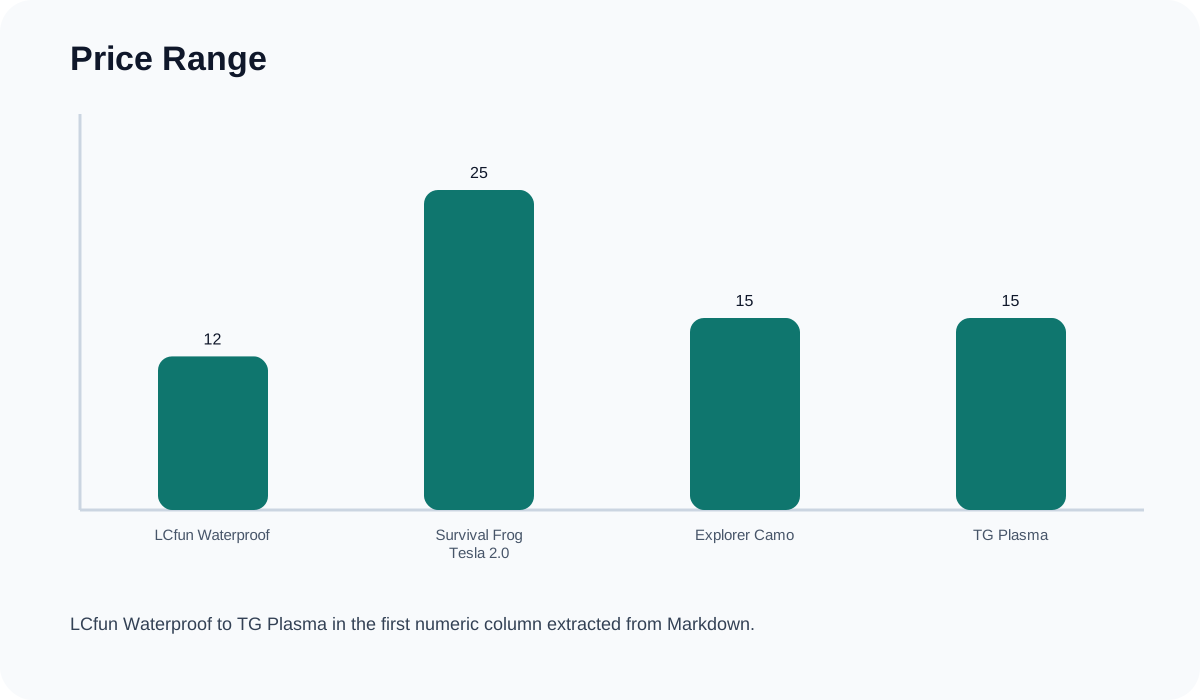
- Price Range: Entry-level, reliable models cost between 30.
- Waterproofing: IP67 ratings are standard, but this protection only applies when the protective latch is completely closed. The plasma arcs cannot be operated underwater.
- Core Limitation: Battery performance degrades significantly in sub-freezing temperatures, and the narrow gap between electrodes requires highly refined tinder.
Top Arc Lighters for Bushcraft Comparison
Comparing the leading entry-level models reveals a highly competitive market prioritizing waterproofing and battery efficiency.
| Product | Price Range | Waterproof Rating | Battery Capacity | Charging Port |
|---|---|---|---|---|
| LCfun Waterproof | 18 | IP67 | 220mAh (~300 lights) | USB-C |
| Survival Frog Tesla 2.0 | 30 | IP67 | 250mAh (~300 lights) | Micro-USB |
| Explorer Camo | 22 | IP67 | 220mAh (~250 lights) | Micro-USB |
| TG Plasma | 20 | IP67 | 220mAh (~300 lights) | Micro-USB |
Note: While USB-C is becoming the modern standard for faster charging and cross-gear compatibility, many reliable legacy models (like the Tesla 2.0) still rely on Micro-USB.
Real User Pain Points
Understanding common failure points is critical for bushcraft beginners relying on electronic fire starters in remote environments.
Performance Analysis
Ignition Capabilities and Arc Design
Entry-level arc lighters almost exclusively utilize a dual-arc design. This cross-pattern creates a larger surface area for ignition compared to single-arc models. However, as indicated by the 35% user complaint rate regarding limited arc space, the physical gap between the electrodes is narrow. Beginners must process their tinder (such as char cloth, fine dry grasses, or feather sticks) much finer than they would when using an open-flame butane lighter.
Environmental Limitations
Arc lighters excel in high-wind conditions where traditional lighters fail. However, cold weather is a severe operational hazard. Lithium-ion batteries (typically 220mAh to 250mAh in these units) lose significant discharge capability in temperatures below freezing. For winter bushcraft, an arc lighter must be kept inside an inner pocket close to body heat prior to use.
Safety and Maintenance Requirements
To operate safely in a survival context, modern arc lighters feature specific built-in protections:
- 10-Second Automatic Shut-off: Prevents the internal lithium-ion battery from dangerously overheating during stubborn fire-lighting attempts.
- Lid Safety Locks: A mechanical requirement to prevent accidental plasma activation while stored in a pocket or packed tightly in a rucksack.
- Electromagnetic Interference (EMI): The high-voltage arc emits EMI, requiring users to operate them away from sensitive navigational electronics.
- Maintenance: Carbon buildup from burning organic material quickly coats the electrodes. If not cleaned regularly, this leads to short-circuiting or a total failure to arc.
Final Verdict
For bushcraft beginners, an arc lighter like the LCfun Waterproof (due to its modern USB-C standard) or the highly reviewed Survival Frog Tesla 2.0 makes an excellent addition to a fire kit. However, due to strict temperature limitations and narrow tinder gaps, they should not replace a primary ferrocerium rod or waterproof matches. They are best deployed as a secondary, wind-immune ignition source.
Bushcraft Arc Lighter Checklist
Before taking an arc lighter into the field, ensure you can check off the following:
- Tinder Prep: Have I practiced making highly fibrous, ultra-fine tinder that fits between the 3-5mm electrode gap?
- Thermal Management: Do I have a warm interior pocket to store the lighter during winter trips?
- Maintenance Kit: Have I packed a small brush or alcohol wipe to clear carbon buildup off the ceramic electrodes?
- Redundancy: Do I have a non-electronic backup fire starter (e.g., ferro rod, stormproof matches)?
- Water Integrity: Is the O-ring clean, and does the safety latch lock securely to guarantee the IP67 rating?